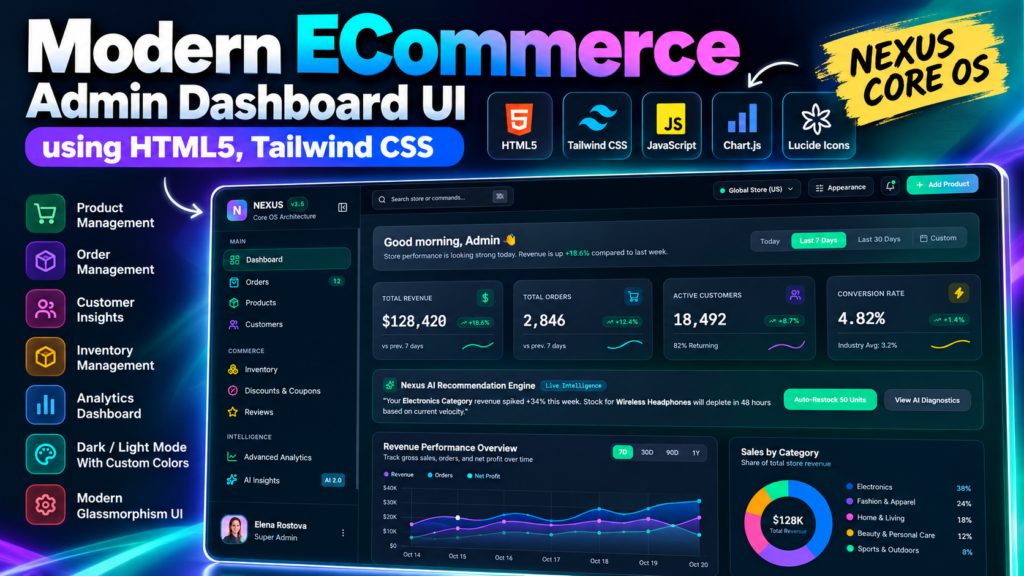
Build a modern online store management interface with Modern ECommerce Admin Dashboard UI using HTML5, Tailwind CSS, JavaScript, Chart.js, and Lucide Icons. Nexus Core OS is a responsive ecommerce admin dashboard designed with a futuristic glassmorphism interface, interactive analytics, product management, order management, customer insights, inventory monitoring, and customizable appearance settings.
The dashboard provides a centralized control center for managing important ecommerce operations while maintaining a modern SaaS-style user experience.
What Is This ECommerce Admin Dashboard?
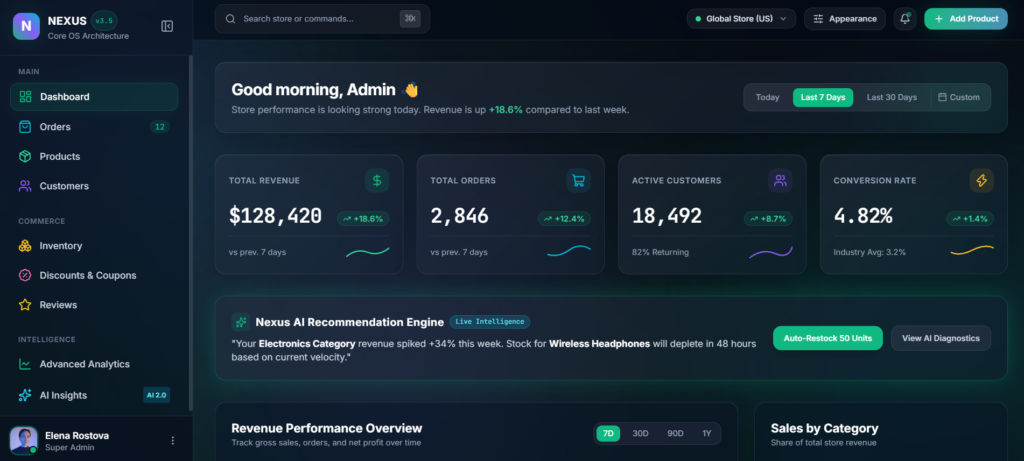
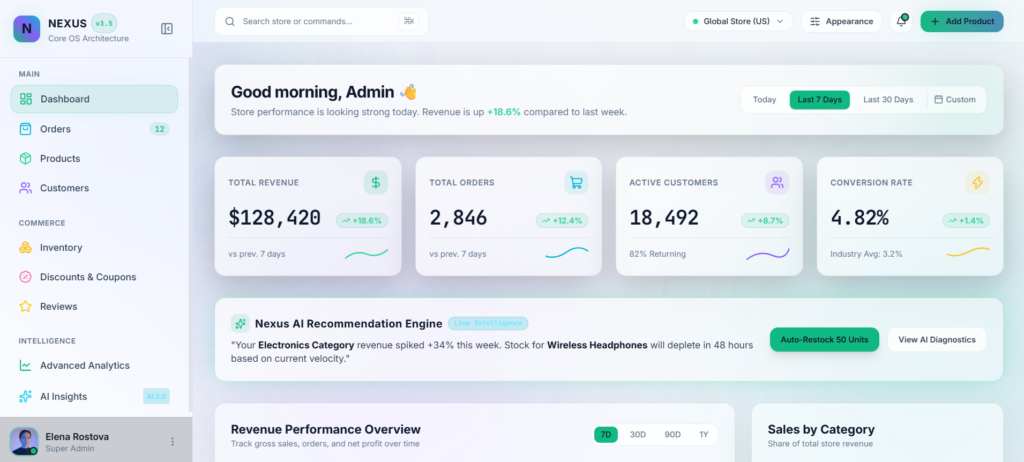
This Modern ECommerce Admin Dashboard UI using HTML5, Tailwind CSS is a front-end dashboard project designed for ecommerce websites and online store management systems.
The interface includes dedicated sections for:
- Dashboard
- Orders
- Products
- Add Product
- Customers
- Inventory
- Discounts & Coupons
- Reviews
- Advanced Analytics
- AI Insights
- Light & Dark Mode
- Glass / Transparent Mode
The navigation is organized into logical Main, Commerce, and Intelligence sections, making it easier to manage different areas of an ecommerce application.
Technology Stack
The Modern ECommerce Admin Dashboard UI using HTML5, Tailwind CSS is built with a lightweight front-end technology stack.
HTML5
HTML5 provides the structure for the dashboard, including navigation, cards, tables, forms, modals, analytics sections, and ecommerce management interfaces.
Tailwind CSS
Tailwind CSS is used extensively for responsive layouts, spacing, typography, colors, cards, buttons, navigation, responsive breakpoints, and dashboard components.
The project also includes a customized Tailwind theme with brand colors, dark surfaces, light surfaces, borders, animations, and custom font families.
JavaScript
JavaScript controls the interactive parts of the dashboard, including navigation, modals, notifications, keyboard shortcuts, appearance settings, charts, product interactions, and dashboard state.
Chart.js
Chart.js powers the interactive analytics visualizations, including the revenue performance line chart and sales-by-category doughnut chart.
Lucide Icons
Lucide Icons are used throughout the interface for navigation, ecommerce actions, search, analytics, customers, products, notifications, settings, and other dashboard controls.
Fonts
The project uses Inter as the primary interface font and JetBrains Mono for numerical and technical elements.
Modern Glassmorphism Dashboard Design
One of the main visual characteristics of this ecommerce admin dashboard is its glassmorphism UI.
The interface uses translucent surfaces, backdrop blur, subtle borders, gradients, shadows, and glowing accents to create a glossy and futuristic appearance.
Users can also switch between transparent glass and solid dashboard appearances depending on their preferred interface style.
Responsive ECommerce Dashboard
The dashboard is designed with responsive Tailwind CSS layouts so that the interface can adapt to different screen sizes.
The responsive interface includes:
- Desktop dashboard layout
- Responsive sidebar
- Mobile navigation drawer
- Responsive KPI cards
- Responsive analytics charts
- Responsive tables
- Mobile-friendly appearance controls
This makes the dashboard suitable for desktop, laptop, tablet, and mobile administration workflows.
Ecommerce Analytics Dashboard
The dashboard includes an analytics-focused overview for monitoring store performance.
Important dashboard metrics include:
- Total Revenue
- Total Orders
- Active Customers
- Conversion Rate
- Gross Revenue
- Net Profit
- Average Order Value
The revenue section also provides different time periods for analyzing performance, including 7 days, 30 days, 90 days, and 1 year.
Product Management
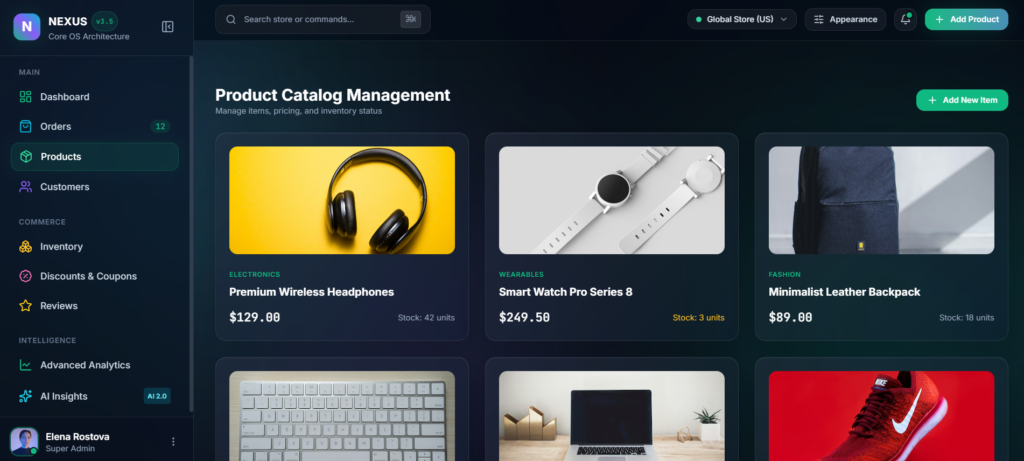
The Product Catalog section provides an interface for managing ecommerce products.
The project includes an Add New Item workflow with fields such as:
- Product title
- Price
- Stock quantity
This front-end interface can be connected to a backend API and database to create a complete product management system.
Order Management
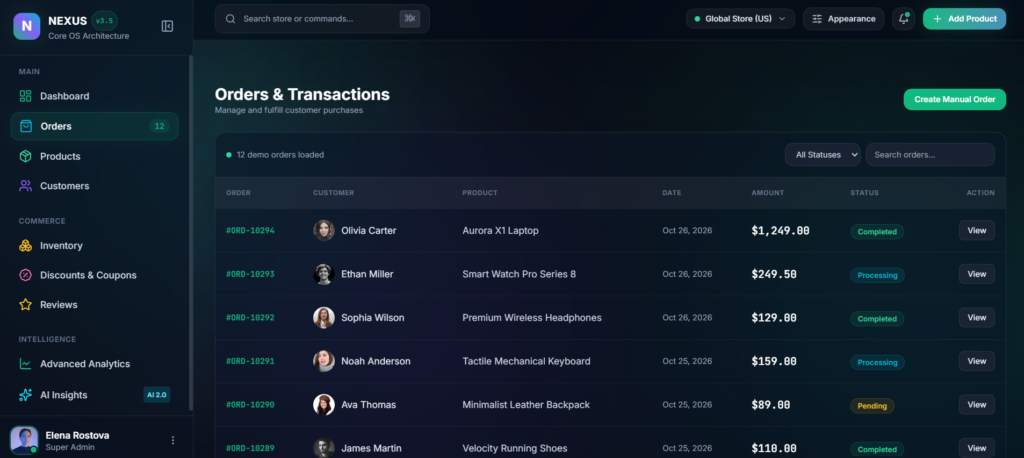
The Orders section provides an ecommerce order management interface.
Administrators can work with information such as:
- Order ID
- Customer
- Product
- Date
- Amount
- Order status
The interface also includes order search and status filtering.
Customer Insights
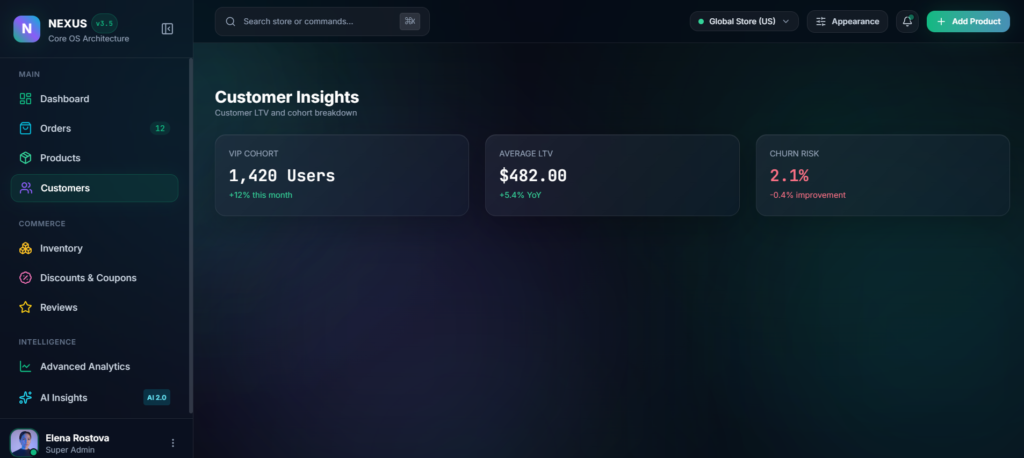
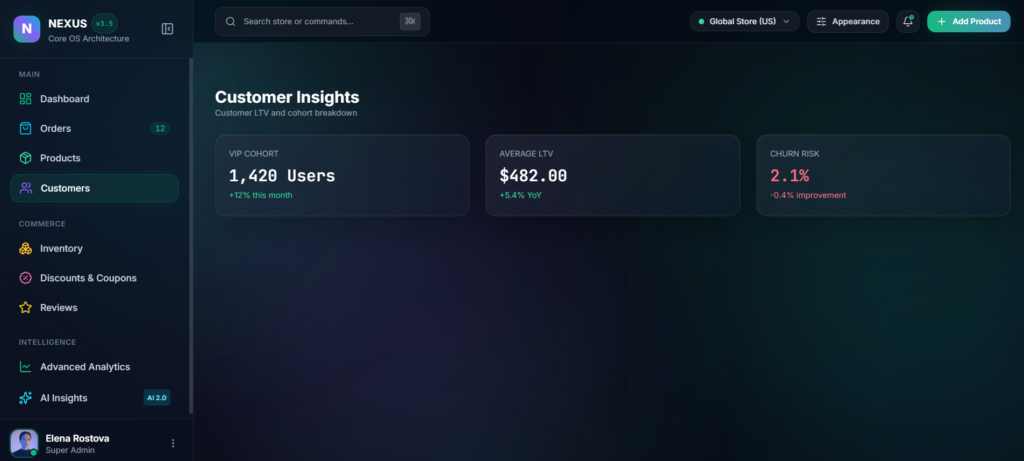
The dashboard includes a Customer Insights section designed to provide information about customer behavior and value.
Example metrics include:
- VIP customer cohort
- Average customer lifetime value
- Churn risk
These components can be connected to real ecommerce data through a backend analytics system.
Inventory Intelligence
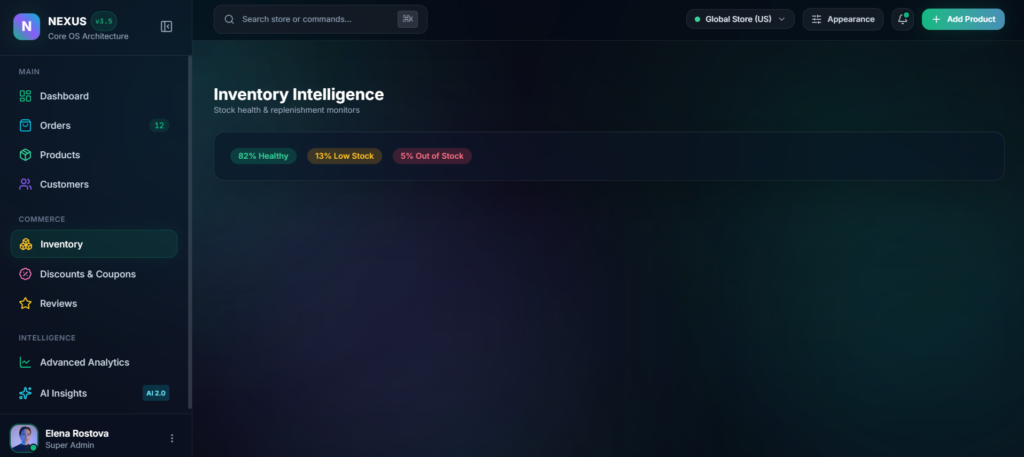
Inventory Intelligence provides a dedicated area for monitoring stock health and replenishment.
This section can serve as the foundation for a production inventory management system connected to product quantities, stock thresholds, suppliers, purchase orders, and automated replenishment workflows.
Custom Dashboard Appearance
The dashboard includes a global Appearance panel that allows users to customize the interface.
Available options include:
- Dark mode
- Light mode
- Glass mode
- Solid mode
- Custom dashboard color
- Compact mode
- Animation settings
The global color system also updates dashboard charts and interface accents.
Command Palette and Keyboard Shortcuts
Nexus Core OS includes a command palette that can be opened using Ctrl + K on Windows/Linux or Command + K on macOS.
The command interface provides quick navigation to areas such as:
- Dashboard
- Orders
- Products
- Analytics
- Add Product
This provides a faster workflow for users who frequently manage large ecommerce stores.
Can This Dashboard Be Connected to a Backend?
Yes. The supplied project is a front-end dashboard interface and can be connected to a backend through APIs.
Developers can integrate the UI with technologies such as:
- PHP
- Laravel
- Symfony
- Node.js
- REST APIs
- GraphQL APIs
- MySQL
- Other database-backed ecommerce systems
The supplied project itself does not include these backend integrations.
Who Can Use This ECommerce Dashboard?
This dashboard can be adapted for:
- Online stores
- Ecommerce websites
- Retail management systems
- Marketplace platforms
- Digital product stores
- Electronics stores
- Fashion ecommerce websites
- SaaS commerce platforms
- Inventory management systems
- Ecommerce analytics applications
Frequently Asked Questions
What is Nexus Core OS?
Nexus Core OS is a modern e-commerce admin dashboard UI designed to provide a centralized interface for managing products, orders, customers, inventory, analytics, and other ecommerce operations.
Is Nexus Core OS a complete ecommerce platform?
No. The supplied Skillhost project is primarily a front-end dashboard implementation. A production ecommerce platform would require backend services, database integration, authentication, payment processing, APIs, and other infrastructure.
What technology is used to build the Nexus Core OS dashboard?
The supplied source uses HTML5, Tailwind CSS, JavaScript, Chart.js, Lucide Icons, Inter, and JetBrains Mono.
Does the dashboard support dark and light mode?
Yes. The Appearance system provides both dark and light themes, along with glass and solid dashboard modes.
Does this ecommerce dashboard support glassmorphism?
Yes. Nexus Core OS includes a dedicated Glass / Transparent Mode that uses translucent surfaces, blur, saturation, borders, and ambient lighting effects.
Can I change the dashboard’s primary color?
Yes. The dashboard includes predefined accent colors and a custom color picker. The selected color is applied through CSS variables and also updates the charts.
What technologies are used to build this e-commerce admin dashboard?
This modern e-commerce admin dashboard is built using HTML5, Tailwind CSS, JavaScript, Chart.js, and Lucide Icons. It also uses Inter and JetBrains Mono fonts for its modern dashboard typography.
Can I use this e-commerce admin dashboard with Laravel?
Yes. The dashboard is a front-end HTML, CSS, and JavaScript interface, so it can be integrated with a Laravel application through APIs, server-side rendering, or other Laravel backend approaches. The supplied project itself does not include a Laravel backend.